
Microbiology
Lyme serology
A serology you should not order the day after a bite: timing is the key to interpreting it.
Updated on July 24, 2025
What is this test for?
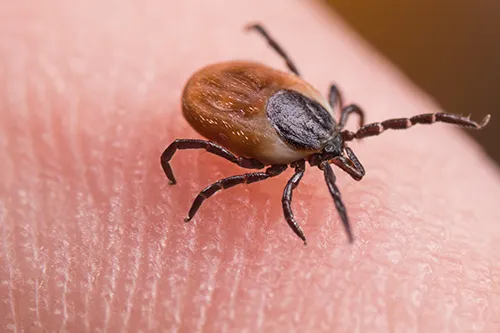
Lyme disease is transmitted by ticks of the genus Ixodes, present across much of Belgium. The serology looks for antibodies made against the bacterium Borrelia burgdorferi.
The Belgian protocol runs in two stages: an ELISA screening test, then, if it is positive or doubtful, a confirmatory test (immunoblot).
- Erythema migrans: a red patch widening around the bite. The diagnosis is clinical — serology is not needed.
- Joint, neurological or cardiac involvement weeks after a bite.
- Prolonged fatigue after forest exposure — to be discussed with your doctor.
- Control after treatment for confirmed Lyme disease.
How to prepare
No preparation. The decisive point is timing: IgM antibodies appear around 3 to 6 weeks, IgG around 6 to 8 weeks. A serology done too early is negative without excluding the disease.
An old positive serology can stay positive for years after a treated infection: it does not prove an active infection.
Reading your results
A negative result beyond six weeks, in a suggestive picture, should open the discussion of other diagnoses — tick co-infection, viral arthritis, inflammation.
| Result | Meaning |
|---|---|
| ELISA negative, no IgG or IgM | No immune response detected |
| IgM alone, < 4 weeks | Early: repeat at 6 weeks |
| IgG + IgM, confirmation positive | Current or past infection |
| Positive serology after treatment | May stay positive for years |
Related tests
 Biochemistry
C-reactive protein (CRP)
The most widely used marker for detecting inflammation and for following its course during treatment.
5 min
Learn more
 Haematology
Erythrocyte sedimentation rate (ESR)
An old test that is still useful: it measures how fast red cells fall to the bottom of the tube.
5 min
Learn more
 Haematology
Full blood count (FBC)
Red cells, white cells and platelets in a single sample: the first reflection of your general health.
5 min
Learn more