
Oncology
PSA: prostate-specific antigen
A useful marker, provided you read it methodically: velocity, free ratio, age and clinical context.
Updated on August 8, 2025
What is this test for?
PSA is a protease produced mainly by the epithelial cells of the prostate, where its role is to liquefy the seminal coagulum. Around 20 % of circulating PSA is free; the rest is bound to alpha-1-antichymotrypsin. The sum of the two fractions is the total PSA.
In practice the test only makes sense in men. A rise can occur in prostate cancer, but also in many benign situations: benign prostatic hyperplasia (BPH), prostatitis, prostatic massage or biopsy, urinary infection, urinary retention, recent sexual intercourse (under 24 h), cycling (normalisation in 48 to 72 h), androgen treatment.
An abnormal value is therefore in no way synonymous with cancer: it is an indicator that opens the door to further tests — free PSA and ratio, velocity, density, MRI, biopsy.
How to prepare
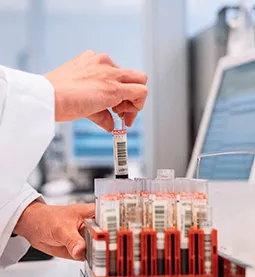
No cycling, no sexual intercourse and no prostatic examination in the 48 hours before the draw. Report a recent urinary infection, cystoscopy or biopsy: the laboratory will note the context, and your doctor may request a retest after six weeks.
The test requires no fasting, at any hour, at all our centres.
Reading your results
Because prostate volume and PSA both rise with age, reference values are age-adjusted. Beyond those thresholds, PSA velocity (the annual rate of rise) and the free/total PSA ratio refine interpretation: a low ratio points more towards cancer, a high one towards BPH.
Large rises (> 20 µg/L) are seen almost exclusively in carcinomas. In the 4 – 10 µg/L band, roughly 80 % of elevations are due to BPH.
| Age | Usual total PSA |
|---|---|
| 40 – 49 years | 0 – 2.5 µg/L |
| 50 – 59 years | 0 – 3.5 µg/L |
| 60 – 69 years | 0 – 4.5 µg/L |
| 70 years and over | 0 – 6.5 µg/L |
Related tests
 Haematology
Full blood count (FBC)
Red cells, white cells and platelets in a single sample: the first reflection of your general health.
5 min
Learn more
 Biochemistry
Blood creatinine and glomerular filtration rate (eGFR)
The kidney does not complain. Creatinine and eGFR let you watch it long before symptoms appear.
5 min
Learn more
 Biochemistry
Lipid profile and lipoprotein(a)
Total cholesterol, LDL, HDL and triglycerides — plus a genetic particle often forgotten: lipoprotein(a).
5 min
Learn more